
Three Differences Between Rental Forecast Software and Traditional Airbnb Income Calculator
I watch investors make the same mistake every week.
I watch investors make the same mistake every week.
They find a property online. They plug the address into a free income estimator. The screen flashes a big, green number: “$60,000 Annual Revenue.” They get excited. They sign the papers. They close the deal.
Six months later, they are writing checks from their personal savings just to keep the lights on. They feel cheated. They wonder if the market crashed.
The market didn’t crash. Their math did.
Most investors rely on basic calculators that track “Vanity Metrics.” These tools show you what comes in. They ignore what goes out. To survive in this business, you need to track “Sanity Metrics.”
This is the difference between going broke and building wealth. You must upgrade your toolkit. You need to move from simple calculators to advanced Rental Forecast Software. This isn’t about getting better data. It is about capital efficiency and survival.
1. The Scope: Gross Revenue vs. Net Operating Income
A basic Airbnb income calculator functions like a simple multiplication machine. It looks at the Average Daily Rate (ADR). It looks at the Occupancy Rate. It multiplies them together.
The result is Gross Revenue. That number sits at the top of the spreadsheet. It looks impressive. But you cannot spend Gross Revenue, you spend what is left over. We call this Net Operating Income (NOI). The gap between these two numbers is where novice investors die.
I analyzed data from mid-sized markets like Asheville, NC, and Boise, ID. The difference is shocking. A standard vacation rental in these areas might generate between $4,500 and $6,000 per month in revenue. A basic calculator stops there. It implies you have $6,000 to spend.
Real estate operation is expensive. The true cost to run that same property often hits $3,500 per month before you even pay the mortgage. This is the “Hidden 50%” that basic tools ignore.
Advanced short term rental software forces you to confront these costs upfront. You have to account for every dollar that leaves your bank account. Here is what that actually looks like in the field:
- Property Management: If you don’t self-manage, this takes 20-25% of your income instantly. That is $900 to $1,500 every single month.
- Utilities: Guests do not care about your electric bill. They leave the AC on with the windows open. This costs $250 to $400 monthly.
- Cleaning and Supplies: You need toilet paper, coffee, and professional cleaners. This runs another $250 to $400.
- Taxes and Insurance: These are non-negotiable. Expect to pay $300 to $450 combined.
When you add these up, your $6,000 month becomes a $2,500 month. If your mortgage is $2,000, you barely broke even. A basic calculator told you that you were rich. The reality is you bought a job.
To see the full breakdown of these costs, you can read our guide on how to Calculate Short-Term Rental Expenses. Understanding these line items is the first step toward accuracy.
This is why we built tools like RentalForecast.com. It allows agents and investors to input these exact figures. You calculate true NOI, not just a fantasy revenue number. You need to know the net profit before you make an offer.
For a deeper understanding of this calculation, AvantStay has excellent resources on How to Calculate Net Operating Income (NOI). The math does not lie, but simple tools often hide the truth.
2. The Timeline: Historical Averages vs. Predictive Seasonality
Basic calculators look backward. They operate on history. They take the last 12 months of data for a zip code and average it out. They assume the future will look exactly like the past.
Financial projections must look forward. The market changes. Travel patterns shift. Relying on a static average is a liability.
Consider two types of investors. Let’s call them the Hobbyist and the Pro.
The Hobbyist uses a free tool. It tells him the property averages $4,000 a month. He budgets his life around that number. He assumes he will get a $4,000 check in November. He is wrong.
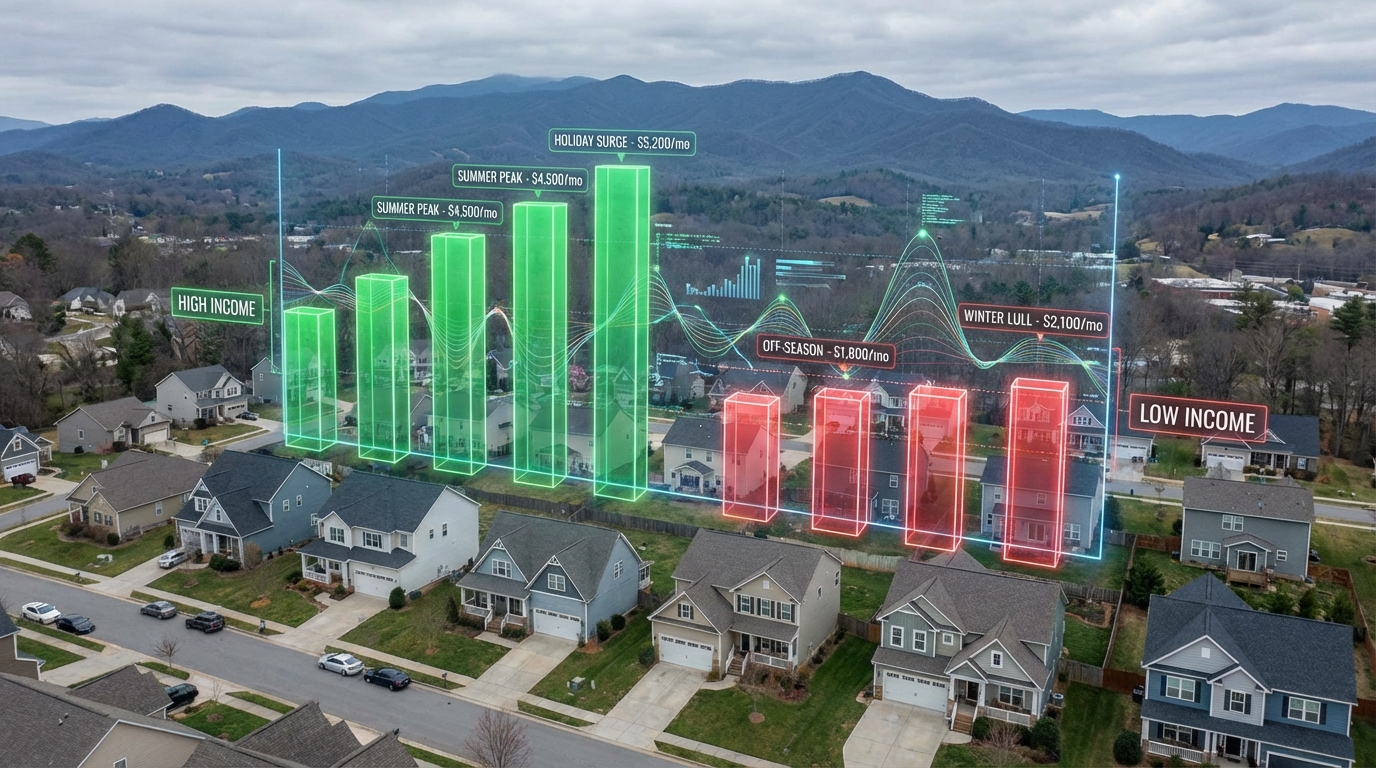
The Pro uses Rental Forecast Software. She sees the predictive seasonality. She knows that July brings in $7,000. She also knows that November crashes to $2,500.
The average is technically the same. The cash flow reality is different. The Hobbyist runs out of cash in November. He cannot pay the mortgage. He faces a liquidity crisis. The Pro kept her July profits in reserve. She survives the winter.
Short-term rentals are volatile. Averages smooth out that volatility. That is dangerous. You need to see the peaks and valleys before they happen.
Tools like AirDNA provide the US 2026 Short-Term Rental Outlook Report that highlights these shifts. They show why forward-looking data is essential. You cannot drive a car looking only in the rearview mirror. You cannot run a business looking only at last year’s tax returns.
By using predictive software, you replace assumptions with clarity. You evaluate opportunities with confidence. You ensure you have enough liquidity to handle the slow months. This is how you stay in the game.
3. The Leverage: Cash Flow vs. Wealth Building (CFROI & DSCR)
We need to talk about capital efficiency. This is the advanced math that turns a landlord into a wealthy investor.
Basic calculators stop at cash flow. They tell you if you have extra money each month. That is good. But it is not the whole story. They do not account for debt leverage or Return on Investment (ROI) in a meaningful way.
Advanced Rental Forecast Software calculates CFROI. This stands for CFROI (Cash Flow Return on Investment). It measures how hard your actual cash is working for you.
There is a specific metric that matters most here. It is called the Debt Service Coverage Ratio (DSCR).
Think of DSCR as a safety rating for banks. It measures if the property’s income can pay the property’s debt. The formula is simple: Net Operating Income divided by Total Debt Service.
- If the ratio is 1.0, you break even.
- If the ratio is 1.25, you are safe.
- If the ratio is below 1.0, you are losing money.
Banks love this metric. If you can prove a high DSCR, you unlock a powerful tool: Strategic Leverage.
Most people think they need personal income to buy a house. They rely on their salary and tax returns. That limits you. You can only buy as much as your salary allows.
When you use accurate software to forecast DSCR, you can qualify for different types of loans. These are often called “DSCR loans.” The lender looks at the house, not you. If the house makes money, they give you the loan.
This is how you scale. You stop trading your personal debt-to-income ratio for mortgages. You start using the asset’s power.
At KWRI, we help investors utilize this strategy through Strategic Investment Financing & Advisory. We use the InvestmentPro+ Series loans. These depend entirely on the property’s performance.
You cannot make this case with a basic calculator. You need precise, defensible data. You need to show the bank that the NOI supports the debt. If you are unfamiliar with these terms, you should review the 3 Key Metrics Airbnb Calculators Measure and Why They Matter.
Advanced software allows you to present a business case to a lender. It transforms you from a risky borrower into a sophisticated partner.
Conclusion
Data is the difference between a liability and an asset. A basic calculator is a toy. It gives you a number that makes you feel good. It often leads you into a trap.
Rental Forecast Software is a tool for professionals. It reveals the hidden expenses. It predicts the seasonal dips. It calculates the leverage you need to build a portfolio.
When we work with clients, we don’t just tell them the numbers. We prove them. Using RentalForecast.com, we generate white-labeled PDF reports. These documents act as a definitive artifact. They show the bank, the partners, and the spouse exactly how the money works.
Once you build this wealth, you must protect it. Accurate forecasts help you acquire assets. Proper structure keeps them safe. We always recommend looking into Asset Protection & LLC Formation to ensure your hard work is not lost to a frivolous lawsuit.
Stop guessing. Stop using free tools for expensive decisions. Use the data. Build the wealth.
Not sure which strategy fits?
Take the investor quiz and get pointed toward the rental strategy that matches your goals — then talk it through with a KW agent who invests for a living.